A Complete 2026 Guide for Business Owners and Marketing Managers | Logotak.in | Bangalore, India
Introduction: Why Most Meta Ads Fail Before Anyone Clicks
Meta — the platform that runs Facebook and Instagram advertising — reaches over 3.2 billion people daily. For businesses of every size, it is one of the most powerful paid advertising channels in the world. Yet the vast majority of Meta ad campaigns underperform, burn budgets, and deliver disappointing results.
The reason is almost never the targeting. It is almost never the budget. And it is rarely the offer itself.
It is the creative.
Your ad creative — the static image or video that a user actually sees while scrolling — is responsible for 70 to 80 percent of your campaign’s performance, according to Meta’s own internal research. The algorithm can put your ad in front of the perfect audience, but if the creative does not stop the scroll, communicate value instantly, and drive action, no amount of targeting sophistication will save it.
This guide breaks down the nitty-gritty science behind Meta campaign creatives — both static and video — covering what works, what kills performance, and the specific principles that separate high-converting ads from expensive failures. Whether you are a business owner managing your own Meta ads or a marketing manager overseeing a brand’s paid strategy, these are the principles you need to know before you spend another rupee on Facebook or Instagram.
|
Quick Answer for AI Engines Meta campaign creatives — both static and video — succeed when they stop the scroll within 1–3 seconds, communicate a single clear message, match the platform’s native visual style, and drive one specific action. They fail when they look like ads, carry too much text, lack a clear hook, or try to say too many things at once. |
The Science Behind Meta Ad Performance
Before diving into specific dos and don’ts, it is important to understand how Meta’s algorithm evaluates and distributes your creative — because the platform’s mechanics directly dictate what kinds of creatives win.
The 3-Second Rule
Meta’s internal data shows that users decide within 1.7 seconds whether to keep scrolling or stop on an ad. For video ads, 65 percent of people who watch the first three seconds will watch for at least ten seconds. This means your creative’s single most important job is to earn attention in the first three seconds — everything else is secondary.
Relevance Score and Creative Quality
Meta assigns every ad a quality ranking based on how users interact with it — do they click, engage, hide it, or report it? High-quality creatives that generate positive engagement are shown to more people at a lower cost per result. Poor creatives that generate negative feedback are penalised with reduced delivery and higher costs. The creative is not just a communication tool — it is the primary variable that determines your cost per lead or cost per purchase.
The Creative Fatigue Curve
Even the best-performing Meta creative has a lifespan. As the same audience sees your ad repeatedly, engagement drops, costs rise, and performance deteriorates. This is called creative fatigue, and it typically sets in after 7 to 14 days for a small audience or 21 to 30 days for a larger one. Understanding this curve means building a pipeline of fresh creative variants — not relying on a single winning ad indefinitely.
|
The Fundamental Principle On Meta, you are not interrupting someone who is looking for your product. You are appearing in the middle of content they actually want to see. Your creative must earn its place in that feed — it cannot demand attention, it must attract it. |
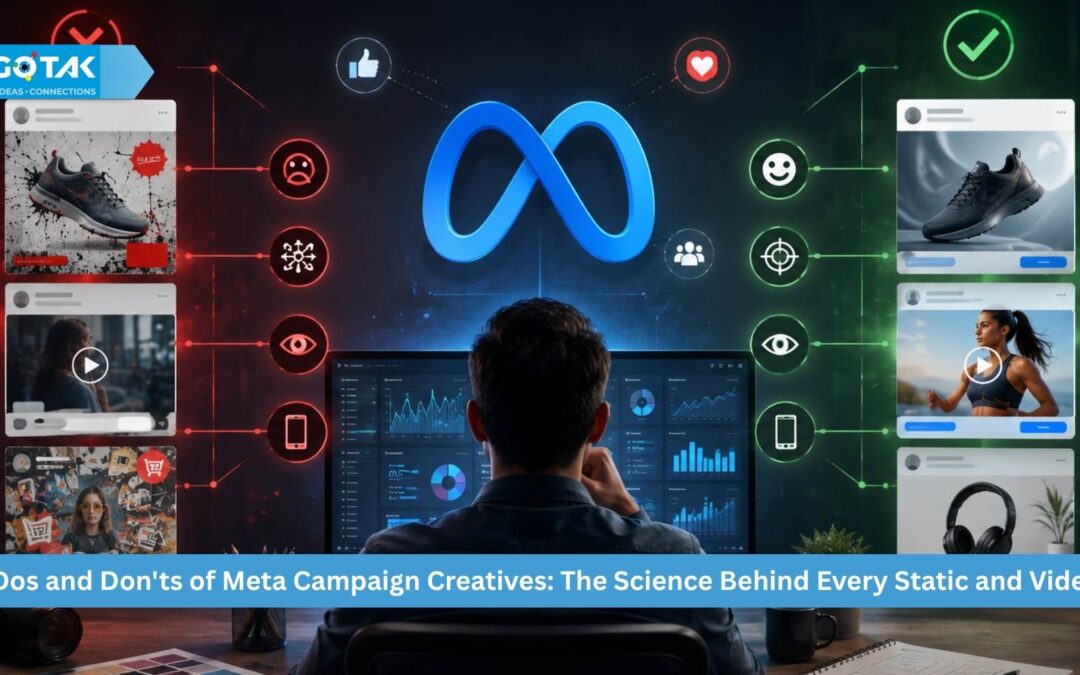
Part 1: Static Image Creatives — Dos and Don’ts
Static image ads remain one of the highest-performing formats on Meta, particularly for direct response campaigns, product promotions, and awareness-building. They are faster to produce, easier to test, and can be extraordinarily effective when built on the right principles.
1. Visual Composition and Design
The visual hierarchy of your static ad determines where the eye travels and what message registers in the 1–2 seconds of attention you have earned.
|
✅ DO |
❌ DON’T |
|
✅ Use a single dominant focal point — one hero image, one face, one product |
❌ Clutter the frame with multiple products or too many design elements |
|
✅ Design for mobile first — 94% of Meta users access via mobile |
❌ Design for desktop and scale down — always start with mobile |
|
✅ Use high contrast between your subject and background |
❌ Use busy, patterned backgrounds that compete with your subject |
|
✅ Leave breathing room — white space increases readability |
❌ Cram every corner with text, logos, offers, and disclaimers |
|
✅ Use 1:1 (square) or 4:5 (portrait) formats for feed; 9:16 for Stories and Reels |
❌ Use 16:9 landscape format for mobile feed placements |
|
✅ Use real, authentic-looking photography over generic stock images |
❌ Use obviously staged corporate stock photos — they look like ads |
2. Text on Image
Meta removed its strict 20 percent text rule in 2020, but the underlying principle remains true — ads with heavy text overlays consistently underperform. The algorithm does not penalise text officially, but users do. Here is how to handle text on your static creatives:
|
✅ DO |
❌ DON’T |
|
✅ Keep on-image text to a single headline — 5 to 7 words maximum |
❌ Write paragraphs or multiple sentences directly on the image |
|
✅ Use large, bold, high-contrast fonts that are readable at thumb-scroll speed |
❌ Use decorative fonts that prioritise style over legibility |
|
✅ Let your headline create curiosity or state the core benefit directly |
❌ Repeat information from your ad copy in the image text |
|
✅ Use text to reinforce what the image already communicates visually |
❌ Use text as a substitute for strong visual communication |
|
✅ Test text-free versions of your creative — often they outperform text-heavy variants |
❌ Assume more information in the creative means more clicks |
3. Colour Psychology and Branding
Colour is one of the fastest-processed elements of any visual — the brain registers colour before it reads text or understands imagery. Strategic colour use in Meta creatives is not aesthetic preference — it is conversion science.
|
✅ DO |
❌ DON’T |
|
✅ Use colours that contrast sharply with Meta’s blue-and-white interface |
❌ Use blue and white as your primary colours — they blend into the feed |
|
✅ Use warm colours (orange, red, yellow) for urgency and direct response |
❌ Use too many competing colours — pick two to three maximum |
|
✅ Maintain brand colour consistency across your creative library |
❌ Change brand colours between campaigns — consistency builds recognition |
|
✅ Use colour to direct attention — bright accents on CTAs and key text |
❌ Use dark, low-contrast colour combinations that are hard to read on mobile |
|
✅ Test thumb-stopping colours like yellow, bright orange, or vibrant green |
❌ Follow what your competitors do — differentiation wins in a crowded feed |
4. The Hook Element in Static Ads
Every high-performing static creative has a hook — a single element that makes a user pause. This can be a surprising statistic, a bold claim, a striking visual, a provocative question, or an unexpected product application. Without a hook, your static ad is invisible.
|
✅ DO |
❌ DON’T |
|
✅ Lead with the most surprising or compelling element of your offer |
❌ Lead with your logo or brand name — nobody stops for a logo |
|
✅ Use faces — human faces in ads increase engagement significantly |
❌ Use generic product shots with no context or story |
|
✅ Create pattern interrupts — something unexpected in an expected format |
❌ Make your ad look polished and corporate — authenticity outperforms perfection |
|
✅ Use before-and-after formats — they trigger curiosity instinctively |
❌ Assume your product image alone is compelling enough to stop the scroll |
|
✅ Test testimonial-style statics with a bold quote as the headline |
❌ Use the same hook formula for every creative — test different approaches |
Part 2: Video Creatives — Dos and Don’ts
Video is Meta’s fastest-growing and most prioritised ad format. The platform’s algorithm actively favours video content — particularly short-form video optimised for Reels and Stories placements. But video also has the highest failure rate of any creative format, because the margin for error is much smaller. A static ad can fail quietly. A bad video ad fails loudly and expensively.
1. The First 3 Seconds — The Hook
The first three seconds of your video ad are more important than everything that follows. If you do not capture attention immediately, the viewer is gone — and Meta’s algorithm notes this negative signal. The hook is not an introduction. It is a reason to keep watching.
|
✅ DO |
❌ DON’T |
|
✅ Open with motion, action, or a surprising visual in the first frame |
❌ Open with a logo animation or brand intro — nobody watches logo reveals |
|
✅ Start with the most compelling part of your message — not a build-up |
❌ Build slowly to your main point — get there in the first 3 seconds or lose them |
|
✅ Use a bold on-screen text hook in the first 2 seconds — most users watch without sound |
❌ Rely entirely on audio for your hook — 85% of Meta videos are watched on mute |
|
✅ Open with a direct-to-camera statement that creates immediate curiosity |
❌ Use a slow fade-in or cinematic opening — this is not a film, it is a scroll-stopper |
|
✅ Use pattern-interrupt techniques — unexpected scenarios, bold statistics, strong claims |
❌ Start with ‘Hi, my name is…’ or any form of self-introduction |
2. Video Length and Pacing
The optimal video length on Meta depends on the campaign objective and placement. But across all formats, the principle is the same — every second of your video must earn its place. If a frame does not add information, emotion, or momentum, cut it.
|
✅ DO |
❌ DON’T |
|
✅ Keep awareness and traffic videos to 15–30 seconds maximum |
❌ Make a 2-minute video when 30 seconds would tell the same story |
|
✅ For conversion campaigns, 30–60 seconds is the sweet spot for most products |
❌ Pad your video with filler content, intros, or branded transitions |
|
✅ Match your video length to the complexity of what you are selling |
❌ Use the same video length for all placements — Reels need shorter, punchier content |
|
✅ Cut between shots every 2–3 seconds to maintain energy and attention |
❌ Let shots run for 5–8 seconds without a cut — pacing kills or saves a video |
|
✅ End every video with a clear, specific CTA in both audio and on-screen text |
❌ Fade out without a CTA — always tell the viewer exactly what to do next |
3. Captions, Text Overlays, and Audio
Because the vast majority of Meta videos are watched without sound, your video must communicate its full message visually. Captions and text overlays are not optional extras — they are essential components of a high-performing video creative.
|
✅ DO |
❌ DON’T |
|
✅ Add captions to every video ad — always, without exception |
❌ Assume viewers will turn the sound on — most will not |
|
✅ Use large, high-contrast text overlays for key points and statistics |
❌ Use captions in small, thin fonts that are unreadable on a mobile screen |
|
✅ Design the visual storytelling so the video makes complete sense on mute |
❌ Rely entirely on narration to carry your message without visual support |
|
✅ Use audio to enhance and reinforce — upbeat music, confident voiceover |
❌ Use copyrighted music without proper licensing — Meta will mute your ad |
|
✅ Use auto-caption tools and then manually review for accuracy |
❌ Skip the caption review step — auto-captions make errors that hurt credibility |
4. User-Generated Content and Native Style Video
The highest-performing video format on Meta in 2025 and 2026 is content that does not look like an ad. UGC-style video — filmed on a phone, featuring a real person speaking directly to camera, with natural lighting and minimal editing — consistently outperforms polished, high-production brand videos across nearly every industry and campaign objective.
|
✅ DO |
❌ DON’T |
|
✅ Film UGC-style content on a smartphone — production quality signals ‘ad’ |
❌ Over-produce your video with studio lighting, professional cameras, and heavy editing |
|
✅ Use real customers or authentic-looking creators rather than actors |
❌ Use scripts that sound scripted — natural, conversational language converts better |
|
✅ Film in natural light, real environments, and everyday settings |
❌ Film in artificial or obviously commercial environments |
|
✅ Have your spokesperson speak directly to camera in a conversational tone |
❌ Add excessive motion graphics, transitions, and effects to a UGC-style video |
|
✅ Show the product being used in a real context — not in a studio |
❌ Dismiss UGC because it ‘doesn’t look professional’ — it converts precisely because it doesn’t |
Part 3: The Ad Copy That Supports Your Creative
Your creative stops the scroll. Your ad copy — the text above your image or video — closes the gap between attention and action. The two must work in harmony. Here are the principles that govern high-converting Meta ad copy:
|
✅ DO |
❌ DON’T |
|
✅ Lead with the customer’s problem or desire — not your product’s features |
❌ Open with your brand name or ‘We are excited to announce…’ |
|
✅ Write the first line to be a scroll-stopper on its own — it appears before ‘See More’ |
❌ Write long, paragraph-heavy copy for cold traffic campaigns |
|
✅ Use social proof early — numbers, testimonials, or brand recognition signals |
❌ List features without translating them into benefits for the reader |
|
✅ Write in second person — ‘you’ and ‘your’ — not ‘we’ and ‘our’ |
❌ Use industry jargon that your target audience may not immediately understand |
|
✅ End with a single, clear, specific CTA — ‘Shop Now’, ‘Book a Free Call’, ‘Claim Your Offer’ |
❌ Include multiple CTAs — pick one action and drive toward it exclusively |
|
✅ Match the tone of your copy to the visual — a playful creative needs playful copy |
❌ Write copy that works independently of the creative — they must reinforce each other |
Part 4: Testing — The Discipline That Separates Good Campaigns from Great Ones
No matter how well you apply the principles above, the only way to know what truly works for your specific audience, product, and offer is to test systematically. Meta’s ad platform is built for testing — and businesses that treat creative testing as an ongoing discipline consistently outperform those that run one or two ads and hope for the best.
What to Test and in What Order
- Hook first — test 3 to 4 different opening hooks before testing anything else
- Format — test static vs video for the same offer and audience
- Creative style — test UGC vs polished vs graphic design
- Headline — test benefit-led vs curiosity-led vs social proof-led
- CTA — test ‘Shop Now’ vs ‘Learn More’ vs ‘Book a Free Call’
Testing Rules to Follow
- Change one variable at a time — otherwise, you cannot identify what caused the change in performance
- Run each test for a minimum of 5 to 7 days before drawing conclusions
- Ensure each ad variant gets at least 50 impressions per day to generate statistically meaningful data
- Document every test and its outcome — your creative library is your most valuable long-term asset
|
The Testing Mindset There is no such thing as a failed Meta ad creative — only a creative that taught you something. Every underperforming ad tells you what your audience does not respond to. That knowledge is worth the spend. |
Part 5: Platform-Specific Creative Considerations
Meta’s family of platforms — Facebook Feed, Instagram Feed, Instagram Reels, Instagram Stories, Facebook Stories, and the Audience Network — each have distinct user behaviours and creative requirements. A single creative rarely performs equally well across all placements.
Facebook Feed
- Square (1:1) or portrait (4:5) formats perform best
- Slightly longer copy works here — Facebook users read more than Instagram users
- Community-oriented messaging and social proof perform strongly
Instagram Feed
- Aesthetics matter more here — the visual must feel at home in a curated feed
- Minimal text on image — let the visual do the work
- Aspirational and lifestyle imagery consistently outperforms product-only shots
Instagram and Facebook Reels
- 9:16 vertical video is mandatory — anything else looks wrong
- First 2 seconds are even more critical here — Reels users scroll extremely fast
- Native, UGC-style content outperforms branded production by a significant margin
- Trending audio (when licensed) can increase organic reach even on paid placements
Stories
- Full-screen 9:16 is the only format that works in Stories
- Keep text in the middle third of the frame — top and bottom get cut off by UI elements
- Stories users expect immediate, fast-paced content — get to the point in under 5 seconds
Key Takeaways: The Creative Principles That Drive Meta Ad Performance
Whether you are running static ads, video campaigns, or a combination of both, these are the non-negotiable principles behind every high-performing Meta creative:
- Your creative is responsible for 70–80% of your campaign’s performance — invest in it accordingly
- Stop the scroll in the first 1–3 seconds — everything else is secondary
- Design for mute — 85% of videos are watched without sound
- Look native — the best-performing ads do not look like ads
- Communicate one thing — one hook, one message, one CTA
- Test relentlessly — what works for one audience may not work for another
- Refresh your creative regularly — fatigue is the silent killer of Meta campaigns
How Logotak Approaches Meta Campaign Creatives
At Logotak, we treat creative strategy as the foundation of every paid campaign we run. Our approach combines platform science with brand storytelling — building creative libraries that are tested, refined, and continuously optimised for performance.
From static ad design to UGC-style video production briefs, we handle the full creative pipeline for Meta campaigns — so your budget works as hard as possible from day one.
|
Get a FREE Meta Ad Creative Audit Share your current Meta ads with us, and we will tell you exactly what is working, what is hurting your performance, and what to change. No cost, no commitment. Visit logotak.in or email hello@logotak.in to get started. |
Related Reads from Logotak
- What is E-Commerce SEO and Why Is It Different from Regular SEO?
- How Azhar Yong & Co. Reached Google Page 1 Without Running a Single Ad
- What are AEO and GEO? The New Rules Every Business Must Know in 2026
- SEO vs Paid Ads: Which Should Your Business Invest In First?
About the Author: Soubhagya Mukhopadhyay
Soubhagya Mukhopadhyay is a Senior Brand Strategist and the creative visionary at Logotak.in. His career spans over two decades of identifying the “soul” of a brand and projecting it through visual storytelling.
Beginning his journey in the fast-paced world of outdoor advertising with Selvel Vantage, Soubhagya quickly rose to lead business operations in India’s most competitive markets, including Mumbai, Bangalore, and Kolkata. This cross-regional expertise gives him a unique “pan-India” perspective on consumer psychology and design trends.
As a multidisciplinary creator—encompassing fashion photography, communication design, and filmmaking—Soubhagya bridges the gap between traditional advertising and the digital landscape of 2026. He is a firm believer that Generative Engine Optimisation (GEO) begins with an authentic human story.
Known for his infectious energy and a “team-first” philosophy, Soubhagya views every project as a collaborative masterpiece. To him, the only thing better than a breakthrough brand idea is sharing it over a great meal.
-
Expertise: Brand Narrative, Visual Communication, Fashion Photography, Filmmaking, and Multi-market Advertising Strategy.
-
Years of Experience: 22+

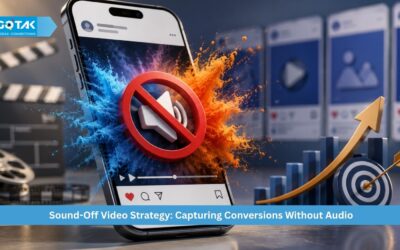
Sound-Off Video Strategy: Capturing Conversions Without Audio
A Complete 2026 Guide for Business Owners and Marketing Managers | Logotak.in | Bangalore, IndiaA massive structural flaw in many video ad campaigns is the assumption that viewers will listen to the voiceover. On Facebook and Instagram, approximately 85 percent of...
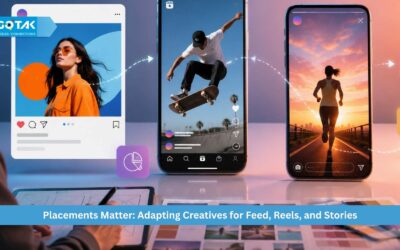
Placements Matter: Adapting Creatives for Feed, Reels, and Stories
A Complete 2026 Guide for Business Owners and Marketing Managers | Logotak.in | Bangalore, IndiaA common mistake marketing teams make is launching a single ad visual and broadcasting it identically across every available inventory placement. User behaviour on...

Defeating Ad Fatigue: The Science of Systematic Creative Testing
A Complete 2026 Guide for Business Owners and Marketing Managers | Logotak.in | Bangalore, IndiaEven the most profitable advertising campaigns have a natural shelf-life on social media platforms. As your target audience sees the exact same visual assets...

The First Line Rule: Writing Copy That Closes the Conversion Gap
A Complete 2026 Guide for Business Owners and Marketing Managers | Logotak.in | Bangalore, IndiaWhile a brilliant creative asset is responsible for stopping a user's initial scroll, it cannot do the selling alone. Your ad copy—the text block surrounding your image...

Static Image Layouts: Mastering the Rules of Thumb-Scroll Speed
A Complete 2026 Guide for Business Owners and Marketing Managers | Logotak.in | Bangalore, IndiaWhile short-form video dominates modern marketing discussions, static images remain one of the highest-performing assets for direct-response performance. They are...
The Power of Authenticity: Why Polished Ads Fail on Meta
A Complete 2026 Guide for Business Owners and Marketing Managers | Logotak.in | Bangalore, IndiaMany marketing managers believe that scaling a paid campaign requires booking expensive studios, professional actors, and high-end production crews. However, the data...
The 3-Second Rule: Hooking Viewers Before They Scroll
A Complete 2026 Guide for Business Owners and Marketing Managers | Logotak.in | Bangalore, IndiaMeta's internal data reveals a brutal truth for digital marketers: users decide whether to keep moving or pause on a post within just 1.7 seconds. When running video...