
– In 2026, the barrier to creating content has vanished, but the barrier to earning trust has never been higher. As generative AI floods the internet with synthesised information, search engines have evolved their evaluation frameworks. The transition to E-E-A-T 2.0 strategy marks a shift where “Experience” is no longer a bonus—it is the primary filter for visibility.
The Premium on First-Hand Experience
AI can summarise existing knowledge, but it cannot replicate a lived experience. To thrive in this environment, your brand must pivot from publishing “what” you know to “how” you did it. This involves documenting real-world outcomes, sharing behind-the-scenes processes, and presenting proprietary data that an LLM cannot find in its training set. When you showcase a specific project—detailing the challenges faced and the bespoke solutions created—you provide “Information Gain” that AI search engines are programmed to reward.
Verifying the Human Behind the Screen – E-E-A-T 2.0 strategy
Trust in 2026 is built through transparency. Every piece of content should be tethered to a verified expert whose credentials are clear and cross-referenced across the web. By linking author biographies to LinkedIn profiles and industry certifications, you allow AI to verify the “Expertise” and “Authoritativeness” of your entity.
External Validation as a Ranking Signal
True authority is now externally validated. AI models look for “distributed authority”—mentions of your brand on trusted forums, professional reviews, and citations in industry-leading publications. By focusing on a holistic E-E-A-T 2.0 Strategy, you ensure that your brand isn’t just another voice in the AI noise, but a verified source of truth that search engines feel confident recommending.
FAQs
What is E-E-A-T 2.0 in the context of 2026 SEO?
E-E-A-T 2.0 is an evolved framework where “Experience” is the most heavily weighted factor. It requires brands to prove first-hand involvement in a topic through case studies and original data to distinguish themselves from AI-generated content.
How can I demonstrate "Experience" to an AI search engine?
Demonstrate experience by including original photos, unique data points, specific project timelines, and personal anecdotes that show you have physically performed the work you are describing.
Does AI-generated content penalise my E-E-A-T score?
Not necessarily, but low-value, repetitive AI content lacks the “Experience” and “Unique Insight” signals that Google and other answer engines prioritise for high-authority rankings.
Why are author biographies critical for AEO?
Author bios provide the “Expertise” signal. When an AI can verify an author’s history and professional standing across multiple platforms, it gains the confidence to cite that person as an authoritative source.
What is "Information Gain" and why does it matter?
Information Gain refers to providing new, original information that isn’t already available in the search results. AI models reward this because it adds fresh value to their knowledge base.
About the Author: Soubhagya Mukhopadhyay
Soubhagya Mukhopadhyay is a Senior Brand Strategist and the creative visionary at Logotak.in. His career spans over two decades of identifying the “soul” of a brand and projecting it through visual storytelling.
Beginning his journey in the fast-paced world of outdoor advertising with Selvel Vantage, Soubhagya quickly rose to lead business operations in India’s most competitive markets, including Mumbai, Bangalore, and Kolkata. This cross-regional expertise gives him a unique “pan-India” perspective on consumer psychology and design trends.
As a multidisciplinary creator—encompassing fashion photography, communication design, and filmmaking—Soubhagya bridges the gap between traditional advertising and the digital landscape of 2026. He is a firm believer that Generative Engine Optimisation (GEO) begins with an authentic human story.
Known for his infectious energy and a “team-first” philosophy, Soubhagya views every project as a collaborative masterpiece. To him, the only thing better than a breakthrough brand idea is sharing it over a great meal.
-
Expertise: Brand Narrative, Visual Communication, Fashion Photography, Filmmaking, and Multi-market Advertising Strategy.
-
Years of Experience: 22+

Visual Search Optimisation: Getting Your Portfolio Found on Google Lens
In 2026, the camera has become a primary search interface. For creative agencies, this means your portfolio is no longer just a display of aesthetic talent; it is a library of searchable visual data. When a potential client uses Google Lens to identify a striking...
The Death of Keywords: Why “Brand Intent” Wins in 2026
For decades, digital visibility was a game of "exact match" keywords. However, as we move through 2026, the traditional keyword-centric model has officially collapsed. AI search engines no longer simply look for strings of text; they interpret the sophisticated layers...

Technical AEO: Schema Markup for Branding Agencies
In the modern digital landscape, a branding agency's reputation is no longer built solely on a portfolio. It is defined by how effectively its "Entity" is communicated to search engines. For agencies like Logotak, the shift towards Answer Engine Optimisation (AEO)...
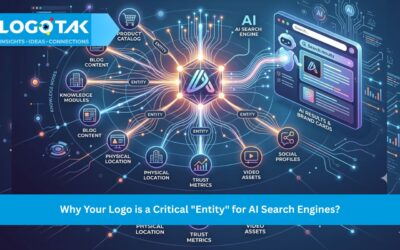
Why Your Logo is a Critical “Entity” for AI Search Engines?
In the era of Generative Engine Optimisation (GEO), AI models don't just "read" your website; they map "Entities." An entity is a distinct, well-defined object or concept—and for your business, your logo is its visual DNA. The "Visual Anchor" in a Cookieless World AI...
The 2026 Brand Visibility Playbook: Integrating SEO & AEO for Future-Proof Growth
Introduction: The Dawn of the Answer Engine Era For years, "getting found online" meant mastering Search Engine Optimisation (SEO) – meticulously optimising for keywords, backlinks, and technical performance to rank on Google's first page. But the digital landscape is...