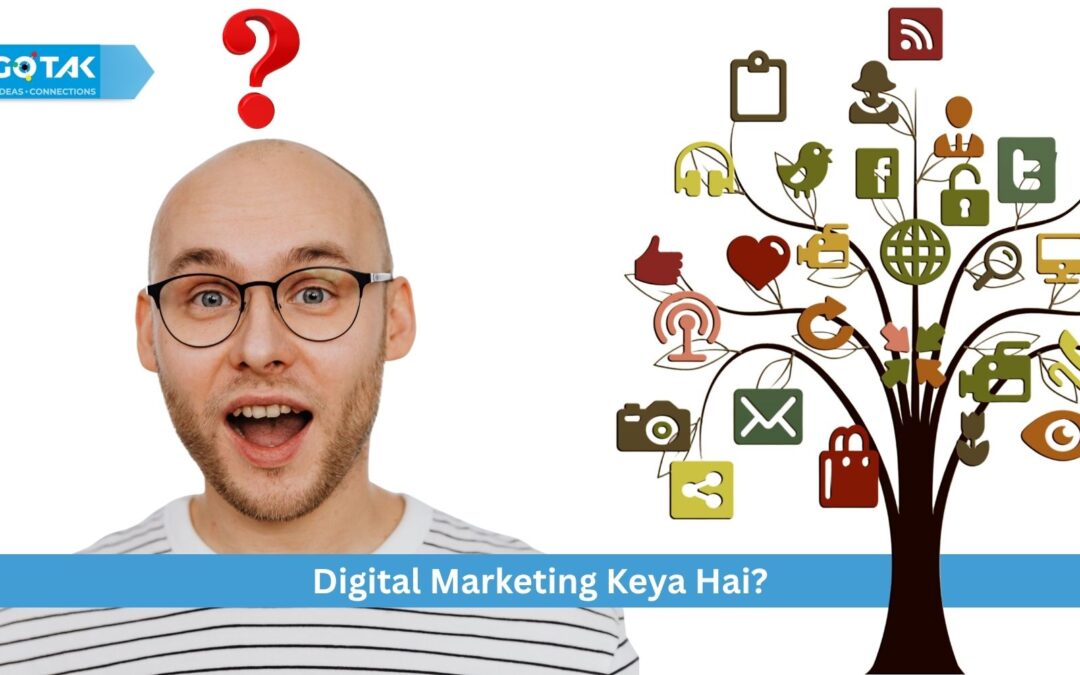
Digital Marketing Keya Hai | Logotak.in | Bangalore, India
What is Digital Marketing?
In an era where billions of people spend their daily lives connected to the internet, traditional marketing methods alone are no longer enough to sustain business growth. Consumers no longer wait for evening television broadcasts or morning newspapers to discover new products; they turn to search engines, scroll through social media feeds, read digital reviews, and stream online video.
To reach these modern consumers, businesses must establish a dominant online presence. This complete guide breaks down everything you need to know about digital marketing: what it is, why it matters, how its core channels operate, and how to build a unified strategy that drives revenue.
Defining Digital Marketing
At its core, digital marketing refers to any promotional effort or brand activity conducted through electronic devices, digital channels, and the internet. It encompasses every tactic used to connect with potential customers where they spend their time: online.
While traditional marketing relies on physical mediums—such as billboards, print ads, direct mail, and radio broadcasts—digital marketing relies on online ecosystems. It allows brands to attract, engage, convert, and retain customers through targeted, data-driven experiences.
Why Digital Marketing is Essential for Business Success
The shift from traditional advertising to digital channels is not merely a modern trend; it represents a fundamental change in consumer behavior. Here is why establishing a robust digital presence is vital:
1. Unmatched Audience Reach
Unlike traditional methods restricted by geography or print runs, digital campaigns can reach global audiences instantly. Whether you run a local service business or an international enterprise, online channels allow you to present your offer to millions of users simultaneously.
2. Precision Audience Targeting
Traditional channels use a broad “spray and pray” approach, hoping the right people see a billboard or magazine ad. Digital platforms allow you to target prospective buyers based on precise demographics, geographic locations, personal interests, search behavior, purchasing history, and online activity.
3. Full Measurability and Analytics
One of the greatest strengths of digital marketing is total transparency. Through web analytics and tracking tools, you can monitor campaign performance in real time. You know exactly how many people viewed your ad, clicked your link, visited your website, and completed a purchase.
4. Cost Efficiency and Higher ROI
Digital campaigns are highly scalable and accessible for budgets of all sizes. Small businesses can launch targeted campaigns with modest spends, measure performance, and scale budgets up as return on investment (ROI) is proven.
5. Interactive Customer Engagement
Digital marketing creates a two-way conversation between brands and consumers. Through comment sections, social media messages, email exchanges, and real-time chat, businesses can gather instant feedback and cultivate lasting relationships.
The Core Channels of Digital Marketing
To build an effective presence, you must understand the primary channels that drive traffic, leads, and sales online.
1. Search Engine Optimisation (SEO)
Search Engine Optimisation (SEO) is the process of structuring and optimising your website to rank higher in organic (unpaid) search engine results pages (SERPs). When users search for solutions, products, or information on Google, SEO ensures your brand appears at the top.
- On-Page SEO: Optimising individual website pages through keyword research, compelling headlines, descriptive meta tags, high-quality copy, and clean URL structures.
- Off-Page SEO: Building domain authority and external trust through high-quality backlinks, brand mentions, guest contributions, and external citations.
- Technical SEO: Enhancing site infrastructure to make it easy for search engines to crawl and index your content. Key technical elements include site speed, mobile responsiveness, SSL security, XML sitemaps, and structured schema data.
2. Content Marketing
Content Marketing involves creating, publishing, and distributing valuable, relevant, and consistent content to attract and retain a clearly defined audience. Rather than pitching products directly, content marketing provides solutions to your audience’s problems, positioning your business as a trusted industry authority.
- Blog Posts and Articles: Written resources that answer buyer questions, target search terms, and drive ongoing search traffic.
- Ebooks and Whitepapers: In-depth, downloadable resources designed to educate users and capture qualified lead information.
- Infographics and Visual Aids: Visual assets that break down complex data into scannable, shareable graphics.
- Video Content: Engaging visual stories, tutorials, and product demonstrations published across platforms like YouTube, Instagram, and LinkedIn.
3. Social Media Marketing
Social Media Marketing leverages platforms like Meta (Facebook and Instagram), LinkedIn, X (Twitter), YouTube, and TikTok to build brand awareness, foster community, and direct traffic back to your primary digital properties.
4. Pay-Per-Click Advertising (PPC)
Pay-Per-Click (PPC) is a paid advertising model where businesses pay a fee each time a user clicks on their ad. Unlike organic channels that take time to build authority, PPC delivers instant visibility and immediate targeted traffic.
- Paid Search Advertising (Google Ads): Text-based ads displayed at the top of search results pages when users search for specific transactional keywords.
- Paid Social Advertising: Visual feed, Story, and Reel advertisements targeted to specific user demographics, interests, and online behaviours across platforms like Facebook and Instagram.
- Display and Remarketing Ads: Visual banner ads shown across partner networks to re-engage users who previously visited your website.
5. Email Marketing
Despite being one of the oldest digital marketing channels, email marketing remains one of the highest-performing mediums for direct ROI. It allows businesses to own their communication channel without relying on third-party platform algorithms.
- Nurture Sequences: Automated series of educational emails sent to welcome new leads and guide them toward a purchase.
- Promotional Newsletters: Broadcast emails highlighting sales, product launches, seasonal offers, or new content releases.
- Transactional Emails: Automated updates including order confirmations, shipping updates, account notifications, and abandoned cart reminders.
6. Affiliate and Influencer Marketing
Partnership-driven digital marketing expands your market footprint by leveraging established audiences created by external creators, bloggers, or publisher networks.
- Affiliate Marketing: A performance-based model where third-party publishers earn a commission for promoting your products and generating tracked sales.
- Influencer Marketing: Partnering with niche content creators to feature your products, offering built-in credibility and direct exposure to engaged audiences.
Understanding the Modern Digital Marketing Funnel
To convert strangers into loyal customers, your digital marketing channels must work together in a structured buyer’s journey. The digital marketing funnel outlines the path a consumer takes from initial discovery to long-term brand loyalty.
Top of the Funnel (TOFU) – Awareness
- Goal: Attract prospective buyers who are experiencing a problem but do not yet know your brand.
- Primary Channels: Organic search articles, educational social media posts, top-of-funnel video content, and broad display campaigns.
Middle of the Funnel (MOFU) – Consideration
- Goal: Engage leads who are actively evaluating potential solutions and comparing options.
- Primary Channels: Downloadable lead magnets, detailed comparison guides, webinars, email sequences, and targeted retargeting ads.
Bottom of the Funnel (BOFU) – Conversion
- Goal: Motivate high-intent leads to take action and make a purchase.
- Primary Channels: High-intent search ads, direct sales pages, case studies, customer reviews, limited-time promotional emails, and live product demonstrations.
Post-Purchase – Retention and Advocacy
- Goal: Turn one-time buyers into repeat customers and active brand advocates.
- Primary Channels: Post-purchase email workflows, loyalty reward programs, exclusive social communities, and customer support channels.
Step-by-Step Guide: Building an Effective Digital Marketing Strategy
Launching disjointed campaigns across multiple platforms leads to wasted budgets and confusing customer experiences. Follow this proven framework to construct a unified digital strategy:
Step 1: Define Your Target Buyer Personas
Identify exactly who you are trying to reach. Outline their age, location, job title, primary pain points, goals, online habits, and preferred content formats.
Step 2: Set SMART Business Goals
Align digital marketing activities with measurable business objectives. Ensure your goals are Specific, Measurable, Achievable, Relevant, and Time-bound (e.g., “Increase organic qualified leads by 35% within 6 months”).
Step 3: Select Your Core Digital Channels
Avoid trying to be everywhere at once. Focus your resources on the core channels where your buyer personas spend most of their time (e.g., LinkedIn and Google Search for B2B; Instagram Reels and Meta Ads for B2C E-commerce).
Step 4: Conduct Audience & Keyword Research
Uncover the exact terms, phrases, and questions your prospective buyers use when searching online. Map these search terms directly to relevant pages across your website and blog.
Step 5: Create High-Value Conversion Assets
Produce conversion-focused content, ad visuals, and email sequences tailored to user intent. Ensure every digital asset includes a single, clear call to action (CTA).
Step 6: Monitor Performance, Test, and Optimise
Review performance data regularly using web analytics tools, ad managers, and email platforms. Continually test creative assets, headline hooks, landing pages, and audience targeting to maximise conversion rates.
Essential Key Performance Indicators (KPIs) to Track
To evaluate whether your digital marketing efforts are successful, monitor these core business metrics:
Key Trends Shaping Digital Marketing in 2026
Digital marketing changes rapidly. Keeping up with emerging shifts is essential for maintaining a competitive advantage.
1. AI and Generative Engine Optimisation (GEO)
Search behaviour is evolving beyond traditional blue links toward conversational AI assistants. Successful brands are structuring content for Generative Engine Optimisation (GEO) and Answer Engine Optimisation (AEO) to ensure their insights are cited directly within AI responses.
2. Short-Form Video Dominance
Short, fast-paced vertical video formats across Reels, TikTok, and YouTube Shorts remain the most effective vehicle for catching attention and building organic reach.
3. Privacy, First-Party Data, and Authenticity
As third-party cookies phase out and privacy protections expand, capturing permission-based first-party data (email lists, SMS opt-ins) is more vital than ever. Additionally, authentic user-generated content (UGC) consistently outperforms overly polished studio ads.
Summary: Taking Action with Digital Marketing
Here is my take: Digital marketing is not a single project—it is a continuous, connected growth framework. By bringing together Search Engine Optimisation, Content Marketing, Social Media, Paid Advertising, and Automated Email sequences into a clear strategy, your business can build a reliable engine that attracts new leads and converts them into loyal customers day after day.
Frequently Asked Questions (FAQs)
1. What is the main difference between traditional and digital marketing?
Traditional marketing uses physical offline channels like billboards, TV, radio, and print ads. Digital marketing uses online channels like search engines, social media, websites, and emails, offering far greater audience targeting, real-time tracking, and interactive engagement.
2. How long does it take to see results from digital marketing?
Timeline varies by channel. Paid advertising (PPC) and paid social can generate immediate traffic and conversions within days. Organic strategies like SEO and Content Marketing typically take three to six months to build authority and drive compound results.
3. Which digital marketing channel is best for my business?
The ideal channel depends on your target audience and business model. B2B organisations often generate strong ROI using Search Engine Optimisation, LinkedIn, and Email Marketing. B2C and E-commerce brands usually perform best with Instagram, Meta Ads, Short-Form Video, and Influencer partnerships.
4. Is SEO better than paid advertising (PPC)?
Neither is inherently better; they serve complementary roles. PPC provides immediate visibility and fast traffic for product launches and promotional offers. SEO builds long-term domain authority and cost-effective organic traffic over time. Combining both yields the highest market coverage.
5. How much should a business budget for digital marketing?
Most growing companies allocate between 7% and 15% of total company revenue toward marketing. Emerging businesses seeking fast market share may spend a higher percentage focused on acquisition, while established brands focus heavily on maintaining market position and customer retention.
About the Author: Soubhagya Mukhopadhyay
Soubhagya Mukhopadhyay is a Senior Brand Strategist and the creative visionary at Logotak.in. His career spans over two decades of identifying the “soul” of a brand and projecting it through visual storytelling.
Beginning his journey in the fast-paced world of outdoor advertising with Selvel Vantage, Soubhagya quickly rose to lead business operations in India’s most competitive markets, including Mumbai, Bangalore, and Kolkata. This cross-regional expertise gives him a unique “pan-India” perspective on consumer psychology and design trends.
As a multidisciplinary creator—encompassing fashion photography, communication design, and filmmaking—Soubhagya bridges the gap between traditional advertising and the digital landscape of 2026. He is a firm believer that Generative Engine Optimisation (GEO) begins with an authentic human story.
Known for his infectious energy and a “team-first” philosophy, Soubhagya views every project as a collaborative masterpiece. To him, the only thing better than a breakthrough brand idea is sharing it over a great meal.
-
Expertise: Brand Narrative, Visual Communication, Fashion Photography, Filmmaking, and Multi-market Advertising Strategy.
-
Years of Experience: 22+

Placements Matter: Adapting Creatives for Feed, Reels, and Stories
A Complete 2026 Guide for Business Owners and Marketing Managers | Logotak.in | Bangalore, IndiaA common mistake marketing teams make is launching a single ad visual and broadcasting it identically across every available inventory placement. User behaviour on...
Defeating Ad Fatigue: The Science of Systematic Creative Testing
A Complete 2026 Guide for Business Owners and Marketing Managers | Logotak.in | Bangalore, IndiaEven the most profitable advertising campaigns have a natural shelf-life on social media platforms. As your target audience sees the exact same visual assets...

The First Line Rule: Writing Copy That Closes the Conversion Gap
A Complete 2026 Guide for Business Owners and Marketing Managers | Logotak.in | Bangalore, IndiaWhile a brilliant creative asset is responsible for stopping a user's initial scroll, it cannot do the selling alone. Your ad copy—the text block surrounding your image...
Static Image Layouts: Mastering the Rules of Thumb-Scroll Speed
A Complete 2026 Guide for Business Owners and Marketing Managers | Logotak.in | Bangalore, IndiaWhile short-form video dominates modern marketing discussions, static images remain one of the highest-performing assets for direct-response performance. They are...

The Power of Authenticity: Why Polished Ads Fail on Meta
A Complete 2026 Guide for Business Owners and Marketing Managers | Logotak.in | Bangalore, IndiaMany marketing managers believe that scaling a paid campaign requires booking expensive studios, professional actors, and high-end production crews. However, the data...

The 3-Second Rule: Hooking Viewers Before They Scroll
A Complete 2026 Guide for Business Owners and Marketing Managers | Logotak.in | Bangalore, IndiaMeta's internal data reveals a brutal truth for digital marketers: users decide whether to keep moving or pause on a post within just 1.7 seconds. When running video...
The Dos and Don’ts of Meta Campaign Creatives: The Science Behind Every Static and Video Ad
A Complete 2026 Guide for Business Owners and Marketing Managers | Logotak.in | Bangalore, IndiaIntroduction: Why Most Meta Ads Fail Before Anyone Clicks Meta — the platform that runs Facebook and Instagram advertising — reaches over 3.2 billion people daily. For...