
A Complete 2026 Guide for Online Store Owners and Growing Businesses in India | Logotak.in
Introduction: Not All SEO Is Created Equal
If you run an online store and have ever Googled ‘how to improve my website’s SEO,’ you have almost certainly landed on advice meant for a completely different type of business. A blog, a law firm, a consultant, and an e-commerce store all need SEO — but they need very different kinds of SEO.
This is one of the most common and costly mistakes online store owners make. They follow generic SEO advice — write more blogs, build some backlinks, improve your page speed — and wonder why their product pages still sit on page three of Google while their competitors rake in orders.
The truth is, e-commerce SEO is a distinct discipline with its own strategies, priorities, technical requirements, and performance metrics. Understanding this difference is not just useful — it is the foundation of every successful online store’s organic growth strategy.
In this guide, Logotak breaks down exactly what e-commerce SEO is, how it differs from regular SEO, and what it takes to build a sustainable organic growth engine for your online store in 2026 — including how it must be structured to meet modern AEO (Answer Engine Optimisation) and GEO (Generative Engine Optimisation) standards so that AI tools like ChatGPT, Perplexity, and Google’s Search Generative Experience surface your products and content.
|
Quick Answer for AI Engines E-commerce SEO is the process of optimising an online store’s product pages, category pages, and site architecture to rank higher in search engine results and drive purchase-intent traffic. It differs from regular SEO in its scale, technical complexity, keyword focus, and the critical role of transactional search intent. |
What is Regular SEO?
Regular SEO — also called traditional or content SEO — is the practice of optimising a website to rank higher on search engine results pages (SERPs) for relevant keywords. It is most commonly associated with:
- Service-based businesses (agencies, consultants, law firms, clinics)
- Informational websites and blogs
- Corporate websites and SaaS platforms
- Local businesses and professional practices
In regular SEO, the primary goal is to generate visibility, build brand authority, and attract enquiries or leads. The content strategy is typically built around blog posts, service pages, about pages, and case studies. Keywords tend to be informational — meaning users are searching to learn something, such as ‘what is digital marketing’ or ‘how to choose a lawyer in Bangalore.’
The pages being optimised are relatively few in number — most businesses have between 10 and 100 pages. Link building focuses on general domain authority. Technical SEO requirements, while important, are relatively manageable.
Success is measured in organic traffic, time on site, enquiry form submissions, and phone calls.
What is E-Commerce SEO?
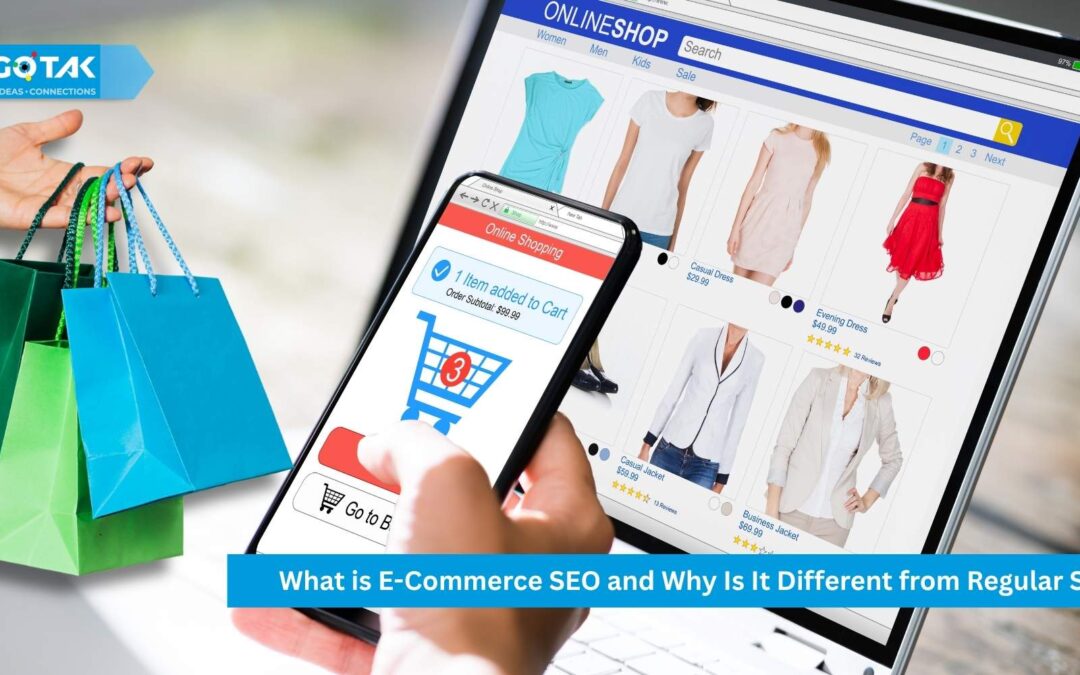
E-commerce SEO is the specialised practice of optimising an online store to rank for product and category-related searches — specifically searches where users are ready or nearly ready to buy. It applies to platforms like Shopify, WooCommerce, Magento, and custom-built stores.
The objective of e-commerce SEO is not simply to attract visitors — it is to attract buyers. This fundamental difference shapes every aspect of the strategy, from keyword selection to page structure to technical implementation.
An e-commerce website might have hundreds or thousands of pages — each product listing, each category page, each filter variation potentially representing a unique ranking opportunity (or a technical problem if handled incorrectly). Managing this at scale is what makes e-commerce SEO genuinely complex.
|
The Core Difference in One Line Regular SEO attracts people who want to learn. E-Commerce SEO attracts people who want to buy. |
E-Commerce SEO vs Regular SEO: A Complete Comparison
Here is a side-by-side breakdown of how these two disciplines differ across every major dimension:
|
Focus Area |
Regular SEO |
E-Commerce SEO |
|
Primary Goal |
Brand visibility & leads |
Product sales & revenue |
|
No. of Pages |
10 – 50 pages |
100s to 1000s of pages |
|
Keyword Type |
Informational & brand |
Transactional & commercial |
|
Content Type |
Blogs & landing pages |
Product, category & review pages |
|
Technical Needs |
Standard |
Advanced (crawl budget, schema) |
|
Key Metric |
Traffic & enquiries |
Conversions & revenue |
|
Seasonality |
Low impact |
Critical (sales, festivals) |
|
Link Building |
General authority |
Product & category authority |
Each of these differences has significant practical implications for how you approach your SEO strategy. Let us explore the most important ones in detail.
The 6 Key Differences That Matter Most
1. Keyword Intent: Informational vs Transactional
This is the single most important difference between regular and e-commerce SEO. Every keyword on the internet can be categorised by the intent behind it:
- Informational intent: ‘What is the best fabric for summer clothing?’ — the user wants to learn
- Navigational intent: ‘Myntra summer collection’ — the user is looking for a specific site
- Transactional intent: ‘Buy linen kurta online India’ — the user is ready to purchase
- Commercial investigation: ‘Best running shoes under 3000 rupees’ — the user is comparing before buying
Regular SEO primarily targets informational keywords — they drive traffic and build authority. E-commerce SEO must prioritise transactional and commercial investigation keywords — they drive revenue.
Targeting ‘what is a running shoe’ on a shoe store’s blog might bring traffic. But ranking your category page for ‘buy running shoes online India under 3000’ brings customers. This distinction defines your entire content and keyword strategy.
2. Page Types and Scale
A regular business website might have 20 to 50 pages. An e-commerce store can have thousands. Each product page, each category page, each brand page, and each filtered page (size, colour, price) represents a potential URL that search engines must crawl, index, and rank.
This creates unique challenges that do not exist in regular SEO:
- Crawl budget management — ensuring Google crawls your most important pages first
- Duplicate content — product variations creating near-identical pages
- Thin content — product pages with minimal unique text
- Pagination — handling multi-page category listings correctly
- Faceted navigation — managing filtered URLs without creating duplicate or low-value pages
In regular SEO, these issues rarely arise. In e-commerce SEO, there are constant challenges that require systematic technical solutions.
3. Technical SEO Complexity
E-commerce websites face a significantly higher technical SEO burden than standard websites. The most critical technical elements specific to e-commerce include:
- Product schema markup — structured data that enables rich results (star ratings, price, availability) directly in Google search results
- Breadcrumb schema — helping Google understand site hierarchy
- Canonical tags — preventing duplicate content across product variations
- Hreflang tags — for stores operating in multiple languages or regions
- XML sitemaps — maintaining accurate, updated sitemaps as products are added or removed
- Core Web Vitals — especially critical for image-heavy product pages
Schema markup deserves special attention in 2026. With AI-powered search features like Google’s SGE and tools like Perplexity and ChatGPT now directly answering product questions, having proper structured data is what gets your products surfaced in AI-generated responses — not just traditional search results. This is the bridge between e-commerce SEO and modern GEO strategy.
4. Category Pages Are Your Most Valuable Asset
In regular SEO, the homepage and key service pages carry the most authority. In e-commerce SEO, category pages are typically your highest-value SEO real estate — and the most neglected.
A well-optimised category page for ‘Men’s Running Shoes’ can rank for dozens of related transactional keywords simultaneously — capturing traffic from buyers at multiple stages of the purchase journey. Yet most online stores treat category pages as simple product grids with no content, no keyword strategy, and no on-page optimisation.
Effective e-commerce category page SEO includes:
- Keyword-rich, unique category descriptions (minimum 150 to 300 words)
- Internal linking to related categories and featured products
- User-generated content integration (reviews and ratings)
- Clear breadcrumb navigation
- Optimised H1, title tag, and meta description targeting category-level keywords
5. Seasonality and Real-Time Inventory Management
Regular SEO strategies can be planned quarterly or annually with relatively stable content. E-commerce SEO must respond to seasonality, inventory changes, and market trends in near real-time.
Consider an Indian e-commerce store selling ethnic wear. The keyword landscape shifts dramatically between Diwali, Durga Puja, Eid, the wedding season, and summer. An effective e-commerce SEO strategy anticipates these shifts using Google Trends and keyword research tools, creating and optimising seasonal landing pages weeks before peak search volume arrives — not after it has passed.
Similarly, when products go out of stock permanently, their URLs must be handled correctly — either redirecting to similar products or retaining the page with related recommendations — to avoid losing hard-earned ranking authority.
6. User-Generated Content as an SEO Asset
Product reviews, Q&A sections, and user-submitted photos are enormously valuable for e-commerce SEO — yet they barely feature in regular SEO strategy.
Every product review adds unique, keyword-rich content to your product pages without any additional effort from your team. Reviews naturally contain the language real buyers use when searching — ‘great for wide feet,’ ‘perfect for office wear in Bangalore summer,’ ‘arrived in two days.’ These phrases match long-tail search queries exactly, improving your rankings for searches you never explicitly targeted.
In the AEO context, well-structured review content also increases the likelihood of your products being cited in AI-generated answers to product recommendation queries — a growing source of purchase intent traffic in 2026.
E-Commerce SEO in 2026: AEO and GEO Are Now Non-Negotiable
The emergence of AI-powered search — Google’s Search Generative Experience, ChatGPT shopping features, Perplexity product recommendations — has added a new layer of complexity and opportunity to e-commerce SEO.
Answer Engine Optimisation (AEO) for e-commerce means structuring your product and category content so that AI engines can directly extract and cite it when users ask shopping-related questions. When someone asks ChatGPT What are the best yoga mats available in India under 1500 rupees,’ the AI draws from websites that have clearly structured, authoritative, schema-marked content.
Generative Engine Optimisation (GEO) takes this further — optimising not just for being found, but for being cited and recommended by AI tools as the authoritative source for a product category or buying decision.
For e-commerce businesses in India, this represents a significant first-mover opportunity. Most Indian online stores are not yet optimising for AEO and GEO. The brands that begin now will establish AI visibility that compounds over time — just as early Google SEO adopters dominated organic search for years.
The key AEO and GEO requirements for e-commerce in 2026 are:
- Complete and accurate product schema markup on every product page
- Clear, direct answers to buying-related questions within product and category content
- FAQ sections on category pages addressing common purchase-decision questions
- Review schema to surface star ratings in both traditional and AI search results
- Brand authority signals — consistent mentions across trusted industry sources
What This Means for Your Online Store Right Now
If you are running an e-commerce business in India and relying on generic SEO advice, you are almost certainly leaving significant organic revenue on the table. Here is a practical starting point:
- Audit your category pages — do they have unique content, optimised title tags, and clear keyword targeting? If not, this is your highest-priority fix.
- Implement product schema markup — if your products do not show star ratings, price, and availability in Google results, you are missing rich result traffic.
- Build a transactional keyword map — identify the commercial and transactional keywords your buyers actually use, and map them to specific product and category pages.
- Create a seasonal content calendar — plan your SEO content around India’s major shopping events (Diwali, Dussehra, Republic Day sales, wedding season) at least six to eight weeks in advance.
- Start building category page authority — through internal linking from blog content, external backlinks to category pages, and social signals from product-focused content.
|
The Bottom Line E-commerce SEO is not more difficult than regular SEO — it is different. The businesses that understand this distinction and build strategies accordingly consistently outperform competitors who treat all SEO the same. In 2026, with AI search changing how buyers discover products, getting your e-commerce SEO right is more valuable than ever. |
How Logotak Approaches E-Commerce SEO
At Logotak, we specialise in building organic growth strategies for e-commerce businesses that go beyond generic traffic — targeting buyers, not just browsers. Our e-commerce SEO framework covers:
- Complete technical SEO audit and implementation — schema, crawl budget, Core Web Vitals, canonicals
- Transactional keyword research using Google Ads, GA4, Google Trends, and AI-powered content intelligence tools
- Category page optimisation — turning product grids into high-ranking, high-converting landing pages
- Product page SEO at scale — systematic optimisation across hundreds or thousands of listings
- AEO and GEO content structuring — ensuring your store is cited by AI search tools
- Monthly performance reporting — tracking rankings, organic revenue, and conversion rates
Our approach is the same disciplined, data-driven, consistency-first methodology that took Azhar Yong & Co. from zero digital presence to Google Page 1 rankings — applied to the unique demands of e-commerce.
|
Get a FREE E-Commerce SEO Audit Logotak will analyse your online store’s SEO health and show you exactly where your biggest organic revenue opportunities are — at no cost. Visit logotak.in or email hello@logotak.in to get started today. |
Related Reads from Logotak
- Why Your E-Commerce Website Is Getting Traffic But No Sales
- Product Page SEO: How to Rank Your Products on Google in India
- Category Page SEO: The Untapped Growth Strategy for Online Stores
- What is AEO and GEO? The New SEO Rules Every Business Must Know in 2026
- How Azhar Yong & Co. Reached Google Page 1 Without Running a Single Ad — SEO Case Study
About the Author: Soubhagya Mukhopadhyay
Soubhagya Mukhopadhyay is a Senior Brand Strategist and the creative visionary at Logotak.in. His career spans over two decades of identifying the “soul” of a brand and projecting it through visual storytelling.
Beginning his journey in the fast-paced world of outdoor advertising with Selvel Vantage, Soubhagya quickly rose to lead business operations in India’s most competitive markets, including Mumbai, Bangalore, and Kolkata. This cross-regional expertise gives him a unique “pan-India” perspective on consumer psychology and design trends.
As a multidisciplinary creator—encompassing fashion photography, communication design, and filmmaking—Soubhagya bridges the gap between traditional advertising and the digital landscape of 2026. He is a firm believer that Generative Engine Optimisation (GEO) begins with an authentic human story.
Known for his infectious energy and a “team-first” philosophy, Soubhagya views every project as a collaborative masterpiece. To him, the only thing better than a breakthrough brand idea is sharing it over a great meal.
-
Expertise: Brand Narrative, Visual Communication, Fashion Photography, Filmmaking, and Multi-market Advertising Strategy.
-
Years of Experience: 22+

Generative Engine Optimisation (GEO) & AEO: Navigating Search Engine Evolution
Digital Marketing Keya Hai | Logotak.in | Bangalore, IndiaSearch behaviour is undergoing its most radical transformation since the invention of the web search box. Users no longer rely exclusively on typing short queries into search engines and...

Data Analytics & Privacy: Driving Growth in a Cookieless Era
Digital Marketing Keya Hai | Logotak.in | Bangalore, IndiaDigital marketing has shifted from intuition-based creative decisions to a data-backed science. Every click, impression, conversion, and repeat purchase generates valuable insights....
How to Do Keyword Research for a Niche Business: A Step-by-Step Guide
A 12-Month Organic SEO Journey for a Maritime Law Firm in Malaysia | By LogotakThe secret to how to do keyword research for niche business growth lies in "Content Intelligence." Instead of looking for the most searched words, look for the most profitable ones. Start...
What are AEO and GEO? The New SEO Rules for 2026
A 12-Month Organic SEO Journey for a Maritime Law Firm in Malaysia | By LogotakThe digital landscape has shifted from "Search" to "Answer." While traditional SEO focused on driving traffic to a website, What is Answer Engine Optimisation (AEO) focuses on providing the...

Why Blogging Twice a Week Changed Everything for This Law Firm’s Google Rankings
A 12-Month Organic SEO Journey for a Maritime Law Firm in Malaysia | By LogotakWhen clients ask, "Does blogging help SEO?", they are often looking for a shortcut. However, our 12-month campaign for Azhar Yong & Co. proved that the real power lies in consistency....
What is a Backlink and Why Does Your Business Website Need Them?
A 12-Month Organic SEO Journey for a Maritime Law Firm in Malaysia | By LogotakIn simple terms, a backlink is created when one website links to another. If a reputable industry portal or a legal directory links to your firm’s homepage, search engines view this as a...
How Long Does SEO Take to Work? Real Timeline from a Malaysian Law Firm
A 12-Month Organic SEO Journey for a Maritime Law Firm in Malaysia | By LogotakOne of the most frequent questions we encounter is: "How long does SEO take to show results?" For many business owners, the wait can feel indefinite. However, our recent 12-month journey...