In the modern digital landscape, a branding agency’s reputation is no longer built solely on a portfolio. It is defined by how effectively its “Entity” is communicated to search engines. For agencies like Logotak, the shift towards Answer Engine Optimisation (AEO) means that technical backend data is just as vital as front-end design.
Bridging the Gap Between Code and Creativity
Traditional SEO focuses on what humans see, but AEO focuses on what machines understand. By implementing structured data, you provide a clear, unambiguous map of your business to AI crawlers. This process involves using JSON-LD code to define your agency’s official name, its founders, its physical location, and its core service offerings. Without this digital handshake, an AI might struggle to distinguish your premium agency from a generic competitor.
The Logic of Connected Entities
The real power of technical optimisation lies in the same property. This specific line of code acts as a digital thread, stitching together your website, your LinkedIn profile, your Instagram, and your Google Business Profile. When these disparate platforms are linked through a single, unified schema, AI models gain “entity confidence”. This confidence is what triggers the appearance of a Knowledge Panel, placing your agency’s logo and credentials front and centre during a search.
Future-Proofing Your Digital Identity
By embedding a specific Service and Review schema, you allow AI to categorise your work with precision. Whether you specialise in logo design or full-scale brand strategy, structured data ensures that when a user asks for an “expert branding agency in Bangalore”, the AI doesn’t just guess—it knows exactly who you are and what you do.
FAQs
What is the benefit of using Schema for a branding agency?
It allows AI search engines to accurately identify your agency as a unique entity, increasing the likelihood of appearing in Knowledge Panels and AI-generated summaries.
Which Schema types are most important for agencies?
The most critical types are Organisation, Service, LocalBusiness, and Review schema, as they define your identity, offerings, and credibility.
How does the 'sameAs' property help with AEO?
This property links your official website to your verified social media profiles and directory listings, helping AI verify your brand’s authenticity across the web.
Can technical Schema improve my agency's E-E-A-T?
Yes. By providing structured evidence of your physical location, professional reviews, and industry certifications, you signal a high level of trustworthiness to AI models.
Do I need to update my Schema regularly?
Yes. You should update your code whenever your services change, your office moves, or you receive significant new industry recognition to maintain “entity accuracy”.
About the Author: Soubhagya Mukhopadhyay
Soubhagya Mukhopadhyay is a Senior Brand Strategist and the creative visionary at Logotak.in. His career spans over two decades of identifying the “soul” of a brand and projecting it through visual storytelling.
Beginning his journey in the fast-paced world of outdoor advertising with Selvel Vantage, Soubhagya quickly rose to lead business operations in India’s most competitive markets, including Mumbai, Bangalore, and Kolkata. This cross-regional expertise gives him a unique “pan-India” perspective on consumer psychology and design trends.
As a multidisciplinary creator—encompassing fashion photography, communication design, and filmmaking—Soubhagya bridges the gap between traditional advertising and the digital landscape of 2026. He is a firm believer that Generative Engine Optimisation (GEO) begins with an authentic human story.
Known for his infectious energy and a “team-first” philosophy, Soubhagya views every project as a collaborative masterpiece. To him, the only thing better than a breakthrough brand idea is sharing it over a great meal.
-
Expertise: Brand Narrative, Visual Communication, Fashion Photography, Filmmaking, and Multi-market Advertising Strategy.
-
Years of Experience: 22+

How to Do Keyword Research for a Niche Business: A Step-by-Step Guide
A 12-Month Organic SEO Journey for a Maritime Law Firm in Malaysia | By LogotakThe secret to how to do keyword research for niche business growth lies in "Content Intelligence." Instead of looking for the most searched words, look for the most profitable ones. Start...
What are AEO and GEO? The New SEO Rules for 2026
A 12-Month Organic SEO Journey for a Maritime Law Firm in Malaysia | By LogotakThe digital landscape has shifted from "Search" to "Answer." While traditional SEO focused on driving traffic to a website, What is Answer Engine Optimisation (AEO) focuses on providing the...
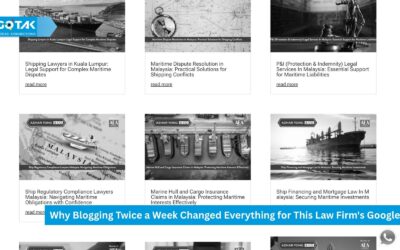
Why Blogging Twice a Week Changed Everything for This Law Firm’s Google Rankings
A 12-Month Organic SEO Journey for a Maritime Law Firm in Malaysia | By LogotakWhen clients ask, "Does blogging help SEO?", they are often looking for a shortcut. However, our 12-month campaign for Azhar Yong & Co. proved that the real power lies in consistency....
What is a Backlink and Why Does Your Business Website Need Them?
A 12-Month Organic SEO Journey for a Maritime Law Firm in Malaysia | By LogotakIn simple terms, a backlink is created when one website links to another. If a reputable industry portal or a legal directory links to your firm’s homepage, search engines view this as a...
How Long Does SEO Take to Work? Real Timeline from a Malaysian Law Firm
A 12-Month Organic SEO Journey for a Maritime Law Firm in Malaysia | By LogotakOne of the most frequent questions we encounter is: "How long does SEO take to show results?" For many business owners, the wait can feel indefinite. However, our recent 12-month journey...
Blog Post: Why Law Firms in Malaysia Cannot Run Google Ads?
A 12-Month Organic SEO Journey for a Maritime Law Firm in Malaysia | By LogotakUnder the strict Legal Publicity Rules 2001, and the recently updated 2026 Bar Council guidelines, advocates and solicitors are prohibited from "touting" or using sensationalist advertising...
Measuring AI Visibility: New Metrics Beyond “Click-Through Rate”
For decades, the success of a digital strategy was measured by the click. We tracked impressions, monitored click-through rates (CTR), and calculated conversions from organic traffic. However, in 2026, as search engines become answer engines, the "click" is no longer...